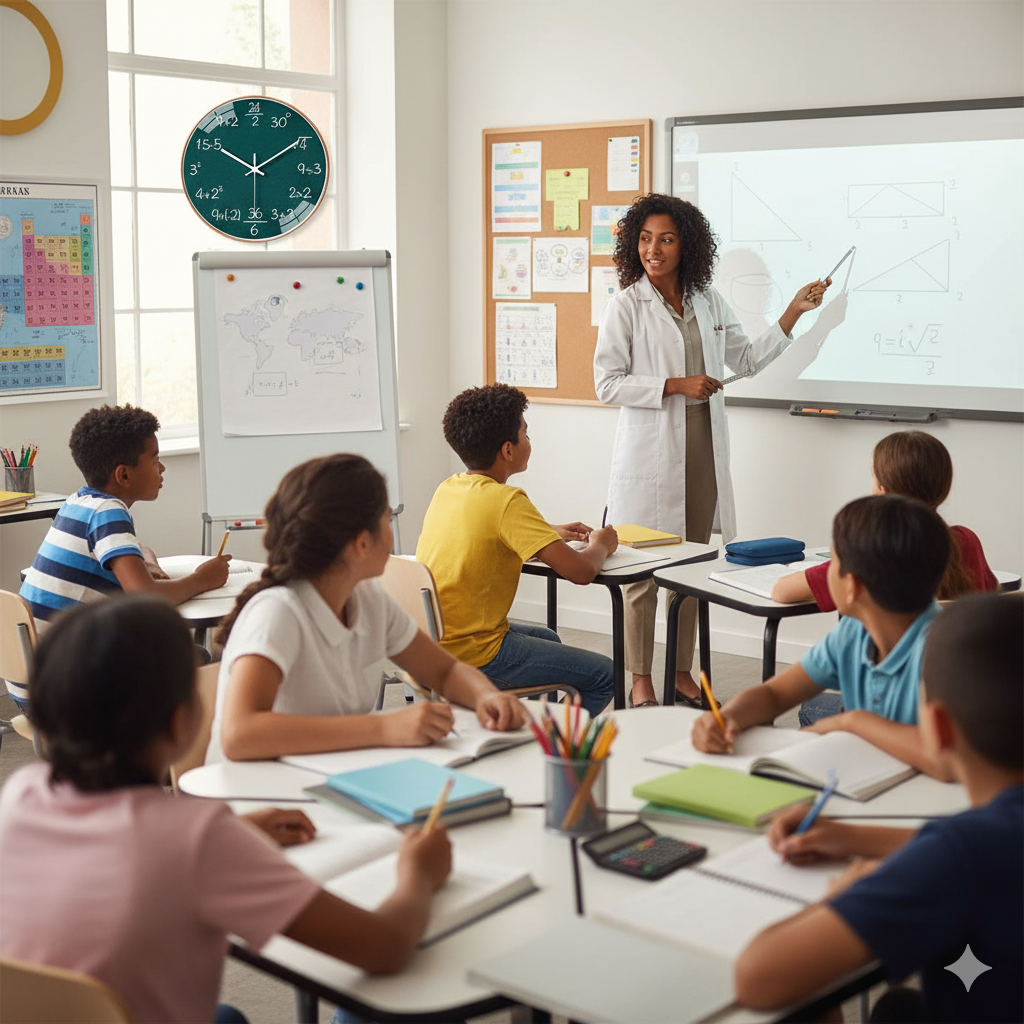
For many children, the clock on the wall is just a way to know when it’s time for lunch or bedtime. But in reality, this simple timepiece is one of the most powerful and underrated educational tools in a classroom or at home. By using a clock, you can help kids not only master time-telling but also build a foundational understanding of core math concepts in a fun, hands-on way. https://amzn.to/4gUtRWI
Here’s how a clock can become a key part of your child’s math journey: https://amzn.to/4gUtRWI
1. Mastering Basic Operations and Number Sense
The clock face is a perfect visual aid for a variety of fundamental math skills.
- Counting by Fives: The numbers around the clock represent the hours, but the minute marks are a perfect tool for practicing skip-counting by fives. Start with the “1” and count “5,” move to the “2” and count “10,” and so on. This is a direct, practical application of multiplication that makes the concept of “5 x 12 = 60” easy to visualize.
- Addition and Subtraction: Use the clock to solve simple word problems. For example, “If it’s 3:00, what time will it be in 25 minutes?” or “It’s 10:15, and we need to leave at 10:45. How many minutes do we have left?” These exercises turn abstract math problems into real-life scenarios. https://amzn.to/4gUtRWI
2. Understanding Fractions and Geometry
A clock is a perfect circular model that can be used to teach more complex mathematical ideas.
- Fractions: The clock is divided into quarters and halves, making fractions easy to understand. You can visually explain concepts like “a quarter past” (15 minutes), “half past” (30 minutes), and “a quarter to” (45 minutes). This connects the abstract concept of a fraction to a concrete, familiar object.
- Angles: The hands of a clock can teach geometry. Ask a child to look at the clock at 3:00 and identify the right angle formed by the hands. At 6:00, they can see the straight angle. This makes the learning of angles less intimidating and more intuitive. https://amzn.to/4gUtRWI
3. Remembering Formulas Through Real-World Application
Connecting math concepts to a tangible object helps solidify formulas in a child’s long-term memory.
- The Circle: The clock’s circular shape is ideal for introducing formulas for a circle’s circumference or area. You can explain how the “roundness” of the clock relates to pi (π) and its relationship to the diameter and radius.
- Elapsed Time: The most critical formula a clock teaches is that of elapsed time. By using the clock face, children can learn to calculate the difference between a start time and an end time. This helps them learn the “formula” that “End Time – Start Time = Duration,” which is a fundamental skill for scheduling and time management. https://amzn.to/4gUtRWI
By integrating the simple, everyday clock into math lessons, you can turn a tedious subject into an engaging and highly practical one. It’s a fun and effective way to ensure children not only learn formulas but also understand why they’re important.
Disclosure: This guide contains Amazon affiliate links. If you purchase through these links, I may earn a small commission at no extra cost to you.”